

What Are the Differences Between Spun Polyester and Filament Sewing Thread?
Spun polyester and filament sewing thread are both made from polyester, but they differ in fibre structure, surface characteristics, sewing behaviour and typical applications. Spun polyester is manufactured from shorter polyester staple fibres that are twisted together to form a continuous yarn. Filament polyester is made from long, continuous filaments, which generally create a smoother and more uniform yarn structure. These structural differences influence appearance, abrasion behaviour, seam characteristics and the way each type performs on different fabrics. Understanding them helps garment manufacturers, footwear producers and industrial buyers select a suitable sewing material instead of choosing solely by fibre composition or price.
Ningbo Derusen Trading Co., Ltd. supplies a range of sewing products, including spun polyester and other polyester sewing varieties. Its available spun polyester specifications cover Tex 18 to Tex 80, with common count combinations from 20/2 to 60/3, more than 800 colour options and ring-spun or TFO production methods. Filament products require a separate specification review because their denier, filament construction, strength and finish depend on the particular product. This article examines the technical differences, explains how they affect actual sewing operations and provides a practical framework for choosing the appropriate material for different production requirements.
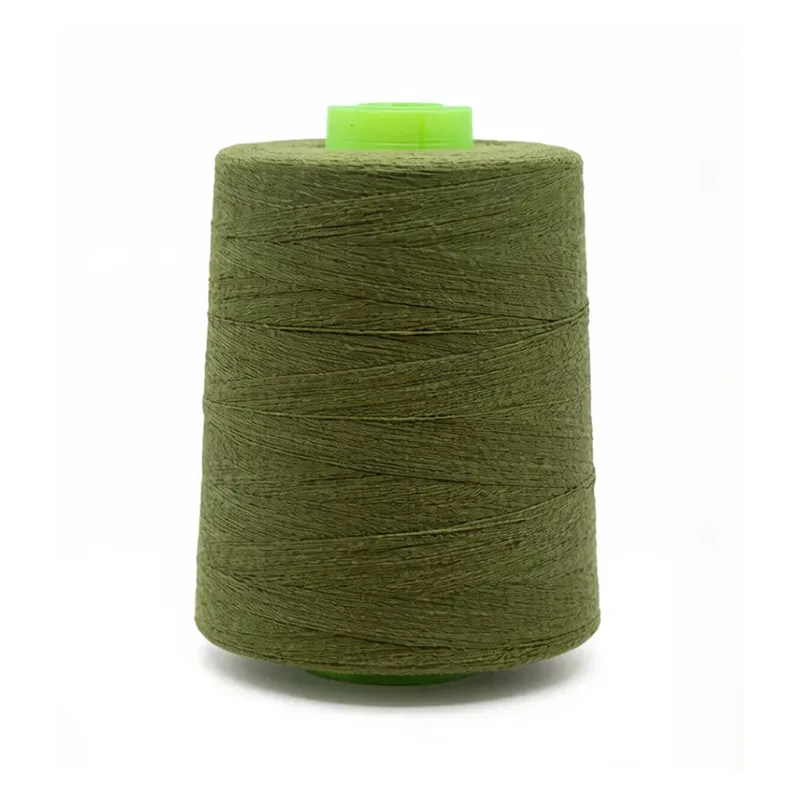
Table of Contents
1. How Do Spun Polyester and Filament Polyester Differ in Fibre Structure?
2. Why Do Their Sewing Performance and Applications Differ?
3. How Should Manufacturers Compare Specifications and Select the Right Product?
How Do Spun Polyester and Filament Polyester Differ in Fibre Structure?
The most fundamental difference between these two materials is the physical structure of the fibres used to make the yarn. Although both are polyester, the manufacturing route creates different surface textures and yarn characteristics. This distinction is important because the surface of a sewing yarn influences friction, handling, visual appearance and interaction with fabric during stitching. Buyers who understand the construction can make a more informed decision when comparing product samples or reviewing a supplier's technical data.
What Is Spun Polyester Sewing Thread?
Spun polyester is produced from polyester staple fibres. These fibres are relatively short compared with continuous filaments and must be aligned, drafted and twisted together to create a yarn with sufficient cohesion. The resulting structure contains many individual fibres held together by twist. Some fibre ends and small surface fibres may remain visible, giving the yarn a characteristic soft or slightly textured appearance.
The production process generally involves several stages:
- Fibre preparation: Polyester staple fibres are opened and blended to improve consistency before spinning.
- Carding and alignment: Fibres are separated and arranged into a more uniform strand.
- Drawing: The strand is drafted to improve fibre alignment and achieve a more consistent linear density.
- Spinning: Twist binds the staple fibres together to form a continuous yarn.
- Plying and twisting: Two or more yarn components may be combined to produce the required count and construction.
- Finishing: The yarn may receive dyeing, lubrication and other finishing treatments according to the intended application.
The use of staple fibres gives spun polyester a surface that can be visually different from a smooth continuous-filament yarn. This does not mean that every spun product has the same degree of hairiness or softness. Fibre quality, spinning equipment, twist level, ply construction and finishing all influence the final result. A well-controlled manufacturing process can produce a consistent yarn with good strength, stable dimensions and a suitable surface for regular sewing operations.
DERUSEN spun polyester products are available in Tex 18 to Tex 80. Common count combinations include 20/2, 20/3, 20/6, 20/9, 30/2, 30/3, 40/2, 40/3, 50/2, 50/3, 60/2 and 60/3. The exact availability of each construction should be confirmed against the current product specification. Ring-spun and TFO options are also part of the supplied product information. These production methods offer different approaches to yarn formation and twisting, so buyers should compare the actual finished yarn rather than assuming that the method name alone determines sewing performance.
What Is Filament Polyester Sewing Thread?
Filament polyester is manufactured from continuous polyester fibres. Instead of combining short staple fibres through a conventional spinning process, the material uses long filaments that extend along the yarn length. Multiple filaments may be grouped, twisted or otherwise processed to achieve the required yarn construction. The result is generally smoother and more uniform in appearance than a staple-fibre yarn.
Continuous-filament construction can offer several structural characteristics:
- Long fibre continuity: The yarn is formed from continuous elements rather than many short fibres joined through spinning.
- Smoother surface: Fewer exposed staple fibre ends generally create a more even surface.
- Consistent appearance: The continuous structure can provide a relatively uniform visual finish.
- Low surface fuzz: Filament construction generally has less staple-fibre hairiness, although the final result depends on processing and handling.
- Different tensile behaviour: Strength and elongation are influenced by filament type, denier, number of filaments, twist and finishing.
Filament yarn should not be treated as one single specification. It may be supplied in different constructions, including multifilament forms, and can vary in linear density, filament count, twist direction and finishing treatment. Buyers should therefore request the precise construction instead of relying on the general term continuous filament. A smooth surface alone does not establish whether a product has the tensile properties, abrasion resistance or needle compatibility required for a particular production line.
How Does the Construction Affect the Finished Yarn?
The differences become clearer when the two structures are compared side by side. The following table describes typical characteristics rather than universal performance guarantees. Actual results depend on the grade, yarn count, construction and manufacturing controls.
| Comparison factor | Spun polyester | Filament polyester |
| Fibre structure | Short polyester staple fibres twisted together | Long, continuous polyester filaments |
| Surface appearance | Generally soft or slightly textured | Generally smoother and more uniform |
| Surface hairiness | Some fibre ends may be visible | Usually lower staple-fibre hairiness |
| Yarn formation | Spinning followed by twisting or plying | Filament grouping and processing, with twisting where specified |
| Visual seam character | Can provide a softer, more textile-like appearance | Can create a smoother and more defined stitch appearance |
| Typical selection considerations | Fabric compatibility, count, softness, seam appearance and cost | Surface smoothness, tensile requirements, abrasion and application conditions |
| Key specification details | Tex, count, ply, twist, strength and finish | Denier or Tex, filament count, twist, strength, elongation and finish |
Linear density is another important point. Spun polyester may be described using a Tex value or a traditional cotton count and ply combination. Filament yarn may be identified by denier, Tex or another system depending on the supplier and market. These units should not be compared without conversion and an understanding of the yarn construction. Two products with similar linear density can still behave differently because their fibre arrangement, twist and finishing are not the same.
For procurement teams, our recommendation is to request a technical data sheet for each construction and compare samples under the same sewing conditions. A product description that only says polyester is not sufficient for a technically sound purchase decision. Derusen can be consulted about the available spun polyester range, while filament requirements should be matched to a confirmed product specification before an order is placed.
Why Do Their Sewing Performance and Applications Differ?
Fibre structure influences how a sewing material moves through the machine, interacts with the needle and forms a seam. However, sewing performance is not determined by structure alone. Linear density, twist, ply, tensile strength, elongation, lubrication, needle selection, machine speed and fabric construction all contribute to the final result. A buyer should therefore avoid assuming that one yarn type is automatically stronger, faster or more suitable for every application. The correct choice depends on the demands placed on the seam and the characteristics of the material being joined.
How Does Surface Structure Influence Sewing Behaviour?
Spun polyester has a staple-fibre surface that can provide a relatively soft and textile-like appearance. This characteristic can be useful in garment production where the visual character of the seam should blend with the surrounding fabric. Its surface structure may also influence friction as the yarn passes through guides, tension discs, the needle eye and fabric layers. The actual friction level depends on the finish, yarn quality and machine settings, not simply on whether the yarn is spun.
Filament polyester generally has a smoother surface because it is made from continuous fibres. This construction can be advantageous when a production process requires a uniform yarn surface and a defined stitch appearance. It may also behave differently under repeated contact with machine components. Nevertheless, smoothness does not guarantee trouble-free sewing. Incorrect tension, unsuitable needle size, poor winding or an incompatible finish can still cause thread breakage, skipped stitches or inconsistent seam formation.
When comparing the two materials on a production line, manufacturers should observe the following points:
- Thread path stability: Check whether the yarn unwinds consistently from the package and passes through the machine without sudden tension changes.
- Needle passage: Confirm that the yarn fits the needle eye and does not show excessive abrasion during sewing.
- Stitch formation: Examine whether stitches remain balanced and consistent across different fabric layers.
- Breakage frequency: Record breaks during a defined production trial rather than relying on a short visual inspection.
- Seam appearance: Compare stitch definition, surface uniformity and the overall appearance of the finished seam.
- Fabric interaction: Check for puckering, damage, excessive friction or other defects caused by an unsuitable combination.
Lubrication is one of the factors that can change machine behaviour. A suitable finish may help control friction as the yarn passes through the sewing system, particularly in applications involving high operating speeds. However, more lubricant is not always better. Excessive or incompatible lubrication can affect downstream processing, fabric appearance or other finishing operations. Buyers should confirm the finish type and suitability for the intended application rather than requesting lubrication without defining the production requirement.
Which Material Is Better for Strength and Abrasion Requirements?
Strength is often a deciding factor in sewing material selection, but it needs to be evaluated through actual test data. A filament structure can provide a continuous load-bearing path, while a spun structure relies on the cohesion and distribution of staple fibres. These construction differences influence tensile behaviour, but they do not establish a universal ranking in which every filament product is stronger than every spun product. A high-quality spun yarn may outperform a lower-grade filament product in a particular test, depending on linear density, twist, raw material and manufacturing control.
For a meaningful comparison, buyers should examine several properties together:
- Breaking force: Indicates the force required to break the yarn under the specified test conditions.
- Elongation at break: Shows how much the yarn extends before failure and helps explain its response under tension.
- Tenacity: Relates breaking force to linear density, making it more useful when comparing products of different sizes.
- Abrasion resistance: Helps assess how the yarn withstands repeated contact and movement.
- Loop and knot performance: Can provide additional information about behaviour under conditions that differ from a straight tensile test.
- Dimensional stability: Matters when the finished seam must maintain its appearance after washing, heat exposure or other processing.
These values should be measured using a defined test method. A strength number without its unit, sample preparation, test method and conditioning conditions is difficult to interpret. Buyers should also distinguish between yarn breaking strength and seam strength. A strong yarn does not automatically produce a strong seam if stitch density, needle choice, tension or fabric construction is unsuitable.
Abrasion performance also depends on the application. Footwear, bags and leather goods may expose seams to repeated rubbing, flexing and localised stress. In these cases, the yarn should be tested in the actual construction or under a relevant laboratory method. A smoother filament surface may be beneficial in some conditions, but the complete yarn design and finish determine the result. Spun polyester can also be suitable for many durable sewing applications when the correct count and construction are selected.
Where Is Spun Polyester Commonly Used?
Spun polyester is widely used in apparel and textile production because it combines polyester's general durability and dimensional stability with a surface character familiar to many garment applications. It can be selected for a range of woven and knitted fabrics, subject to the correct count and machine setup.
Typical applications include:
- Clothing: General garment assembly, seams, hems and other routine sewing operations.
- Workwear: Selected uniforms and garments where the seam must withstand regular use and laundering.
- Footwear: Fabric components, lining and other sewn sections where the yarn specification matches the material and seam design.
- Hats and accessories: Stitching applications that require a consistent appearance and suitable handling.
- Leather goods: Selected leather and synthetic leather products, subject to appropriate needle, yarn and seam testing.
- Handicrafts: Textile-based products and small manufactured goods where colour availability and stitch appearance are important.
DERUSEN's spun polyester range includes more than 800 colour options according to the supplied product information. This breadth can help buyers coordinate sewing materials with different fabric colours and product collections. Colour selection should still be checked against a physical shade reference because screen displays, lighting and fabric surfaces can affect perceived colour. For bulk orders, an approved sample or colour standard helps reduce the risk of visible differences between production batches.
When Should Buyers Consider Filament Polyester?
Filament polyester is worth evaluating when a production specification calls for a smoother continuous-fibre construction, a particular tensile profile or a specific surface appearance. It may be considered for technical sewing applications, selected footwear and leather products, luggage, bags and other products where seam performance needs to be assessed against defined mechanical requirements.
It is important to distinguish ordinary filament polyester from specialised high-tenacity or bonded products. These are not interchangeable descriptions. A high-tenacity product has to meet the relevant strength requirements, while a bonded product receives a treatment intended to hold its constituent filaments together and support particular sewing conditions. Buyers should not assume that every continuous-filament yarn is bonded or has the same high-strength performance.
In production planning, our approach is to define the required seam function first. If the priority is a soft textile appearance for regular garment sewing, spun polyester may be an appropriate starting point. If the specification emphasises a smooth continuous-fibre structure or particular mechanical properties, filament polyester deserves evaluation. Ningbo Derusen Trading Co., Ltd. offers several sewing material categories, but each application should be matched to a documented product specification and confirmed sample.
How Should Manufacturers Compare Specifications and Select the Right Product?
Choosing between spun and filament polyester requires more than comparing two product names on a quotation. A purchasing decision should connect the yarn specification with the fabric, seam construction, machine conditions, finishing process and final use of the product. A material that performs well on one garment line may not be suitable for a thick footwear assembly or a leather product with different needle and abrasion requirements. The most reliable selection process combines technical documentation with a controlled sewing trial.
Which Product Specifications Should Be Reviewed First?
For spun polyester, linear density and yarn count are useful starting points. DERUSEN's supplied spun polyester range covers Tex 18 to Tex 80, with common count combinations from 20/2 to 60/3. These values help buyers narrow the selection, but they should not be used as a substitute for a complete data sheet. The same count designation can be interpreted differently across systems, so the supplier should confirm the unit and construction of the quoted product.
| Product detail | Spun polyester information | What buyers should confirm for filament polyester |
| Linear density | Tex 18 to Tex 80 | Denier or Tex value and tolerance |
| Count construction | Common combinations include 20/2 to 60/3 | Filament count, ply and yarn construction |
| Production method | Ring-spun or TFO options | Filament formation, twisting and any additional processing |
| Colour range | More than 800 colours reported | Available shades, colour matching and batch consistency |
| Package formats | Cones of 1,000 to 20,000 yards or 1 to 2 kg; small bobbins of 50 to 1,000 yards | Package weight, winding length, cone dimensions and unwinding suitability |
| Lubrication | Optional silicone lubrication | Finish type, application level and compatibility with the sewing process |
| Mechanical properties | Confirm breaking force and elongation for the selected count | Confirm breaking force, tenacity, elongation and test methods for the selected grade |
| Quality requirements | Check knots, hairiness, winding and colour consistency | Check filament uniformity, winding, surface condition and package consistency |
The table provides a procurement framework, not a claim that all values are available in every product configuration. For example, a package length of 20,000 yards should be confirmed for the selected count and cone format. Similarly, optional silicone lubrication should be specified in the purchase order if it is required. Buyers should avoid treating a range-level specification as a guarantee that every count, colour and package size is available for immediate shipment.
How Do Yarn Count and Ply Affect the Selection?
Yarn count describes linear density, but different numbering systems express it in different ways. Tex is a direct system in which the number indicates the mass in grams of 1,000 metres of yarn. Denier expresses the mass in grams of 9,000 metres. Other systems, including cotton count, use an indirect relationship in which a higher number can represent a finer yarn. This is why buyers should not compare count figures without first confirming the system being used.
Ply describes how many yarn components are combined. A two-ply construction and a three-ply construction may differ in thickness, strength, flexibility and stitch appearance. However, the result depends on the linear density of each component and the twisting process. A higher ply number does not automatically mean a better sewing result. The finished yarn must be appropriate for the needle size, fabric thickness and seam requirements.
For filament products, buyers should request the denier or Tex value and the number of filaments where applicable. Filament count can help explain the construction, but it should be reviewed alongside twist and mechanical test results. A filament yarn with a smooth surface may still be unsuitable if its linear density or tensile characteristics do not match the production requirement.
How Should a Sewing Trial Be Conducted?
A controlled trial is one of the most useful ways to compare two candidate products. Testing should use the actual fabric, needle, stitch type, machine settings and production speed planned for regular manufacturing. Changing several variables at once makes it difficult to identify why one yarn performs differently from another.
A practical trial can be arranged in the following sequence:
- Define the application. Record the fabric composition, fabric weight, number of layers, seam type and finished product requirements.
- Choose comparable samples. Select products with suitable linear density and construction for the same sewing operation.
- Confirm the machine setup. Record needle system and size, stitch length, upper and lower tension, machine speed and other relevant settings.
- Run an initial test. Check threading, unwinding, stitch formation and any immediate signs of abrasion or breakage.
- Conduct a production-length trial. Observe performance over a meaningful period rather than judging the yarn from a few stitches.
- Inspect the seam. Review stitch balance, seam appearance, puckering, fabric damage and consistency.
- Evaluate after finishing. Where relevant, inspect samples after washing, pressing, heat exposure or other processes used in the actual product workflow.
- Document the result. Record the sample identification, machine settings, test conditions, defects and final approval decision.
Manufacturers should pay attention to winding quality during this process. Poor package winding can cause irregular unwinding tension even when the yarn itself has acceptable tensile properties. Cone shape, winding density, package stability and the direction of unwinding can all influence machine operation. If the production line experiences repeated tension changes, buyers should investigate the package and yarn path before assuming that the fibre type is the cause.
What Quality-Control Questions Should Be Asked of a Supplier?
Supplier evaluation should cover both product consistency and the ability to provide accurate technical information. A product catalogue is useful for identifying available categories, but a purchase decision should be supported by specifications for the exact grade and package. Buyers should ask for the following information:
- What is the exact fibre construction and material composition?
- Which linear density, count and ply combinations are available?
- What are the breaking force and elongation values for the selected product?
- Which test methods and conditioning procedures are used?
- What twist level and twist direction are specified?
- Is the product supplied with lubrication, and what finish is used?
- What colour-matching and batch-control procedures are followed?
- How are package winding and visible defects inspected?
- What package lengths, net weights and cone formats are available?
- Can the supplier provide samples for a production trial before bulk purchasing?
DERUSEN's supplied manufacturing information includes the use of textile machinery, dyeing and finishing processes, and quality checks intended to support consistent sewing material. The company also reports the use of dyes formulated without azo compounds and formaldehyde. Buyers with restricted-substance requirements should request current test reports or relevant compliance documentation for the exact product and colour rather than treating a general statement as proof of compliance for every item.
The supplier also describes a quality-control target of no knots over 10,000 metres. This should be understood as a stated product or inspection claim, not an automatic guarantee for every count, colour and production batch. If knot frequency is critical to an automated line, buyers should define the acceptance method and ask how the claim is measured and recorded.
Our factory assessment should also consider packaging, order consistency and communication. Buyers need to know whether repeat orders can be matched to approved samples, how colour references are recorded and how product changes are communicated. These details are particularly important for brands producing several collections or factories operating multiple sewing lines. Derusen can be asked to provide the relevant sample and technical information for the selected spun polyester specification, while filament products should be assessed against their own confirmed data sheets.
How Can Buyers Avoid Common Selection Mistakes?
One common mistake is choosing by price per kilogram without checking the actual usable length, linear density and sewing performance. Two packages with the same net weight may not contain equivalent yarn constructions. Another mistake is comparing a spun count directly with a filament denier without converting the units. Buyers may also overlook the effect of lubrication, winding and machine settings, then attribute every production issue to the fibre type.
Other avoidable errors include:
- Assuming all polyester sewing products have identical strength and elongation.
- Using the same needle and tension settings for different yarn constructions without a trial.
- Assuming that filament polyester is always stronger or more durable than spun polyester.
- Ordering a bulk colour before approving a physical shade sample.
- Comparing supplier claims without checking test methods and product grade.
- Confusing standard spun polyester with high-strength, bonded or specialised industrial products.
- Failing to specify package format, winding length and lubrication requirements.
A reliable purchase specification should identify the fibre type, yarn count or linear density, ply or filament construction, colour, package format, finish and required mechanical properties. It should also state the intended sewing application so that the supplier can recommend a suitable product rather than simply quote the nearest available count. This approach reduces ambiguity between the buyer's expectations and the material actually delivered.
For buyers comparing products from Ningbo Derusen Trading Co., Ltd., the most practical next step is to share the fabric details, sewing operation, target seam properties and preferred package format. A sample evaluation can then establish whether spun polyester or a suitable filament construction offers the better balance of appearance, machine performance and cost for the intended production line.
Conclusion
The main difference between spun polyester and filament polyester lies in fibre construction. Spun polyester uses short staple fibres twisted together, creating a softer and more textured surface that is widely used in garment and general textile sewing. Filament polyester uses continuous fibres, generally producing a smoother and more uniform yarn. Neither structure is universally superior. The right choice depends on the required seam appearance, tensile properties, abrasion conditions, fabric construction, machine settings and finishing requirements.
DERUSEN offers spun polyester in Tex 18 to Tex 80, with multiple count combinations, more than 800 reported colour options, ring-spun or TFO production choices, and different package formats. Filament specifications should be confirmed separately according to the required construction and application. Contact Ningbo Derusen Trading Co., Ltd. with your fabric details, sewing conditions and target specifications to request suitable samples and product information. Our team can help you compare available options and identify a sewing material that fits your production requirements.
Frequently Asked Questions
1. Is spun polyester or filament polyester better for everyday garment sewing?
Spun polyester is a common choice for everyday garment sewing because its staple-fibre structure provides a textile-like surface and is available in a range of counts and colours. Filament polyester may also be suitable when a smoother yarn surface or a particular mechanical property is required. The best option depends on fabric type, seam design, stitch appearance, machine settings and the product's performance requirements. A sewing trial using the actual fabric is the most reliable way to make the final decision.
2. Is filament polyester always stronger than spun polyester?
No. Continuous-filament construction does not automatically make every filament product stronger than every spun product. Breaking force and tenacity depend on linear density, raw material quality, filament or staple characteristics, twist, ply and manufacturing controls. Buyers should compare test results for the exact products, including breaking force, elongation and test method. Seam strength must also be evaluated because stitch density, needle selection, tension and fabric construction influence the strength of the completed seam.
3. What does Tex mean when purchasing spun polyester sewing thread?
Tex is a direct linear-density unit that expresses the mass in grams of 1,000 metres of yarn. A higher Tex value generally indicates a heavier yarn, while the actual thickness and sewing behaviour also depend on construction and finish. DERUSEN's supplied spun polyester range covers Tex 18 to Tex 80. Buyers should confirm the exact Tex value, tolerance, ply construction and recommended application for the selected product rather than choosing solely by a count number.
4. Can spun polyester and filament polyester use the same sewing machine settings?
Not necessarily. Differences in surface structure, linear density, twist, lubrication and tensile behaviour can affect unwinding tension, needle passage and stitch formation. Even when two products have similar nominal thickness, they may require different tension or needle adjustments. Manufacturers should run a controlled trial using the intended fabric, needle, stitch length and machine speed. They should record the settings and inspect stitch balance, breakage frequency, seam appearance and fabric condition before approving the material for regular production.
5. What information should buyers provide when requesting a polyester sewing thread quotation?
Buyers should provide the intended application, fabric composition and weight, seam construction, required yarn count or linear density, colour reference, expected mechanical properties and preferred package format. For filament products, the required denier or Tex value and filament construction should also be stated where known. It is useful to include the machine type, operating conditions and any lubrication or compliance requirements. Providing these details allows the supplier to recommend a more appropriate specification and prepare samples for evaluation before bulk purchasing.
Previous:No News
Send Inquiry
-
E-mail